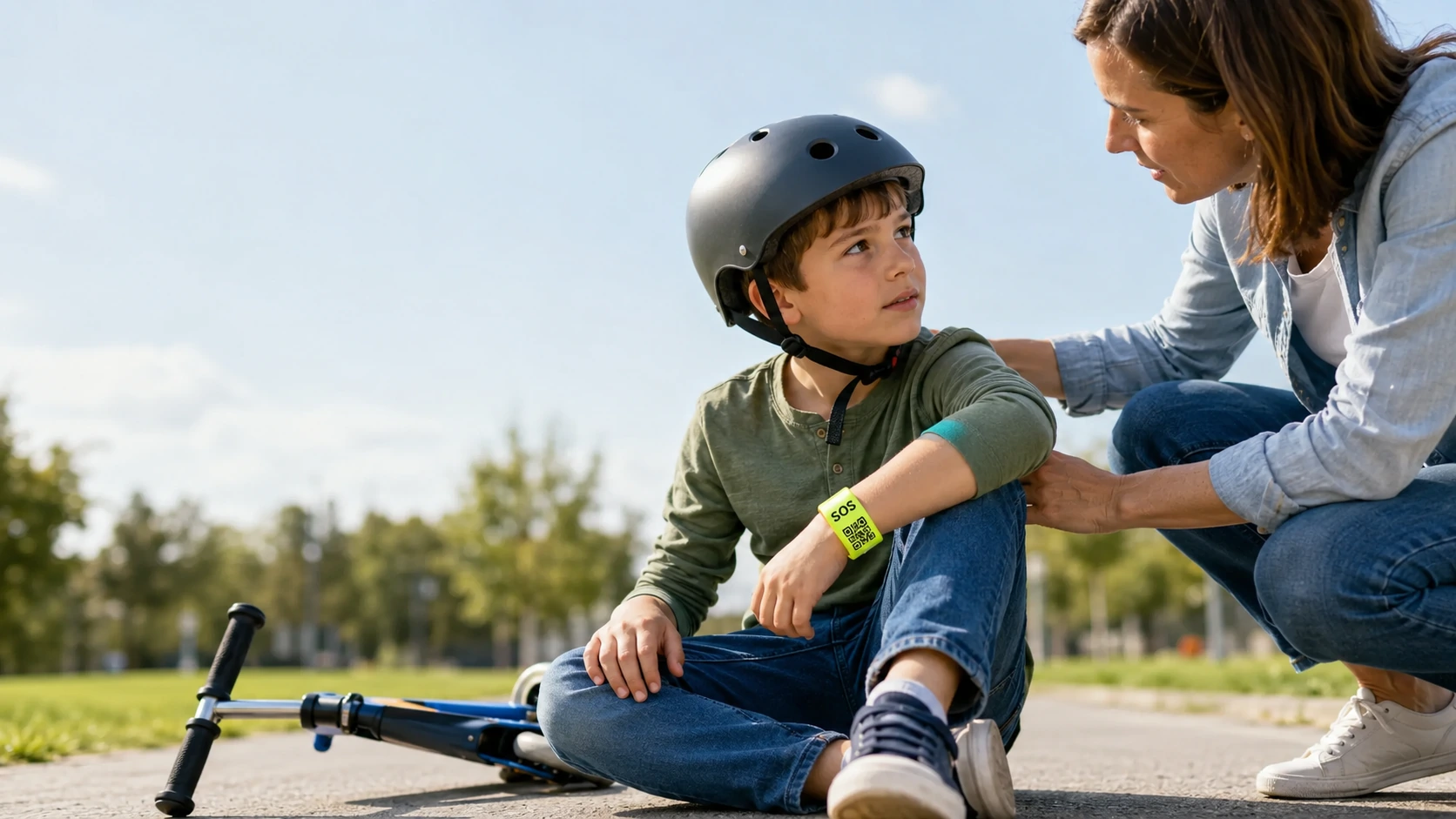
Scooter accidents in children can happen within seconds. A child loses balance, hits a kerb or falls onto a hard surface. Suddenly, an ordinary afternoon in the park becomes an emergency.
The risk becomes even more concerning when the child is riding alone or with friends. A parent may not be nearby. In addition, the child may not carry a phone, wallet, medical card or written emergency contact details.
When an injured child is frightened, confused or unconscious, they may also be unable to explain who they are. Therefore, adults at the scene may have no immediate way to contact the parents or learn about important allergies, medical conditions or medication.
A wearable emergency ID can help close this information gap.
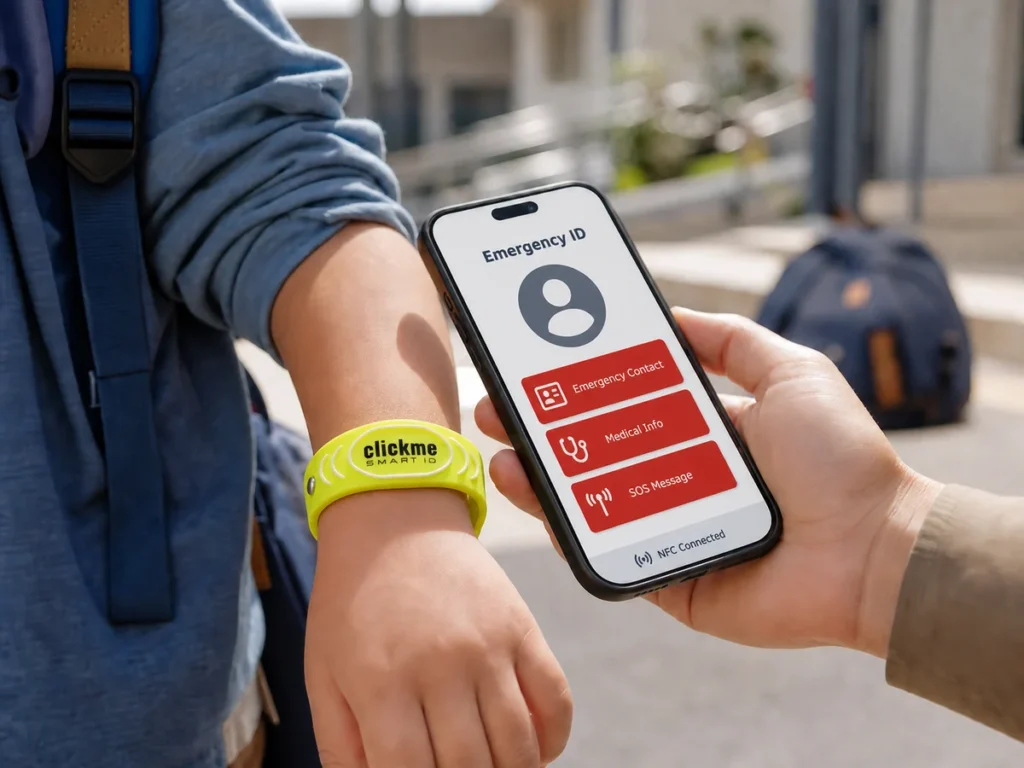
An emergency ID bracelet can help another person identify an injured child, contact their parents and view optional emergency information. With an NFC and QR-enabled bracelet, the information can be opened using a compatible smartphone without requiring the child to carry a phone.
Scooters are popular because they are compact, affordable and fun. Children use them near schools, in parks, around playgrounds and in residential areas.
However, scooters also have small wheels and a relatively high centre of gravity. A pothole, kerb, loose stone or sudden movement can quickly cause a fall. The United States Consumer Product Safety Commission warns that small scooter wheels can stop suddenly when they hit uneven surfaces or obstacles, throwing the rider forw
Recent statistics show how rapidly micromobility injuries have increased:
A newer Johns Hopkins Children’s Center study examined 2,117 recorded paediatric e-scooter injuries between 2020 and 2024. The number increased every year, and 42.2% of all recorded cases occurred in 2024 alone. Children aged 11 to 14 formed the largest age group, while boys represented around 70% of the injured child
These findings do not mean that scooters are the leading cause of every type of childhood injury worldwide. However, they clearly show that scooter-related trauma is becoming an increasingly important child safety issue.
The latest hospital data are even more alarming.
Children’s Health Ireland reported in July 2026 that e-scooters had become the leading cause of traumatic brain injury among children admitted to the Neurosurgery and Rehabilitation Services at CHI at Temple Street.
E-scooter injuries accounted for more than one-third of all traumatic brain injury admissions there during 2026. Admissions for e-scooter-related brain injuries also increased by 50% within twelve months. During the summer, CHI emergency departments were treating an estimated one to two children with e-scooter injuries every
Among 30 children admitted with e-scooter-related traumatic brain injuries between May 2024 and June 2026:
These figures relate to a group of seriously injured children admitted to a specialist hospital. They should not be interpreted as the outcome of every scooter fall. Nevertheless, they show how severe a scooter accident can become.
The visible injury is only one part of the emergency.
Imagine that a child is riding a scooter to a friend’s house. The child falls and cannot speak clearly because of pain, panic, concussion or shock. Their friends may know a first name but not the parents’ telephone numbers. The child may have no phone or identification with them.
The adults who stop to help may need answers to several urgent questions:
Emergency services will always follow their professional procedures. However, being able to identify the child and contact a parent quickly can still provide valuable context and reduce uncertainty.
A parent can confirm the child’s identity, provide relevant background information and reach the hospital as soon as possible.
Older children may carry smartphones. However, relying entirely on the child’s phone has several weaknesses.
The phone may be:
Younger children often do not have their own phone at all.
A bracelet stays physically attached to the child. It remains visible and does not require the child to remember a password, unlock a device or explain where their emergency information is stored.
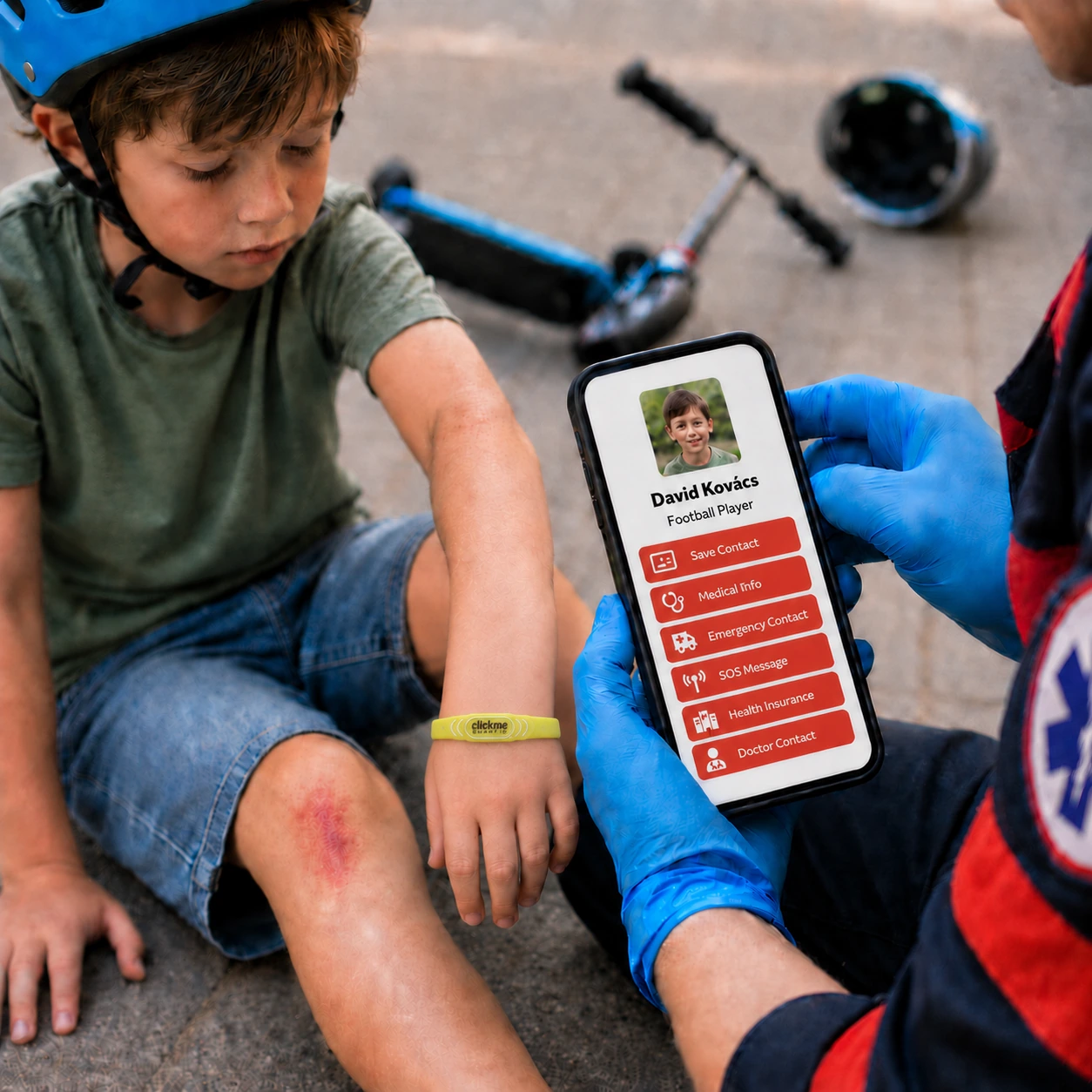
The ClickMe SOS NFC ID Bracelet for Kids combines an NFC chip with a visible QR code. Another person can open the child’s online SOS profile in two ways:
The profile opens directly in the phone’s browser, so no special application is required. The information can also be updated online whenever necess
This means the child does not need to carry a smartphone. The person providing assistance uses their own phone to access the profile.
The neon yellow colour also makes the bracelet easy to notice during outdoor activities.
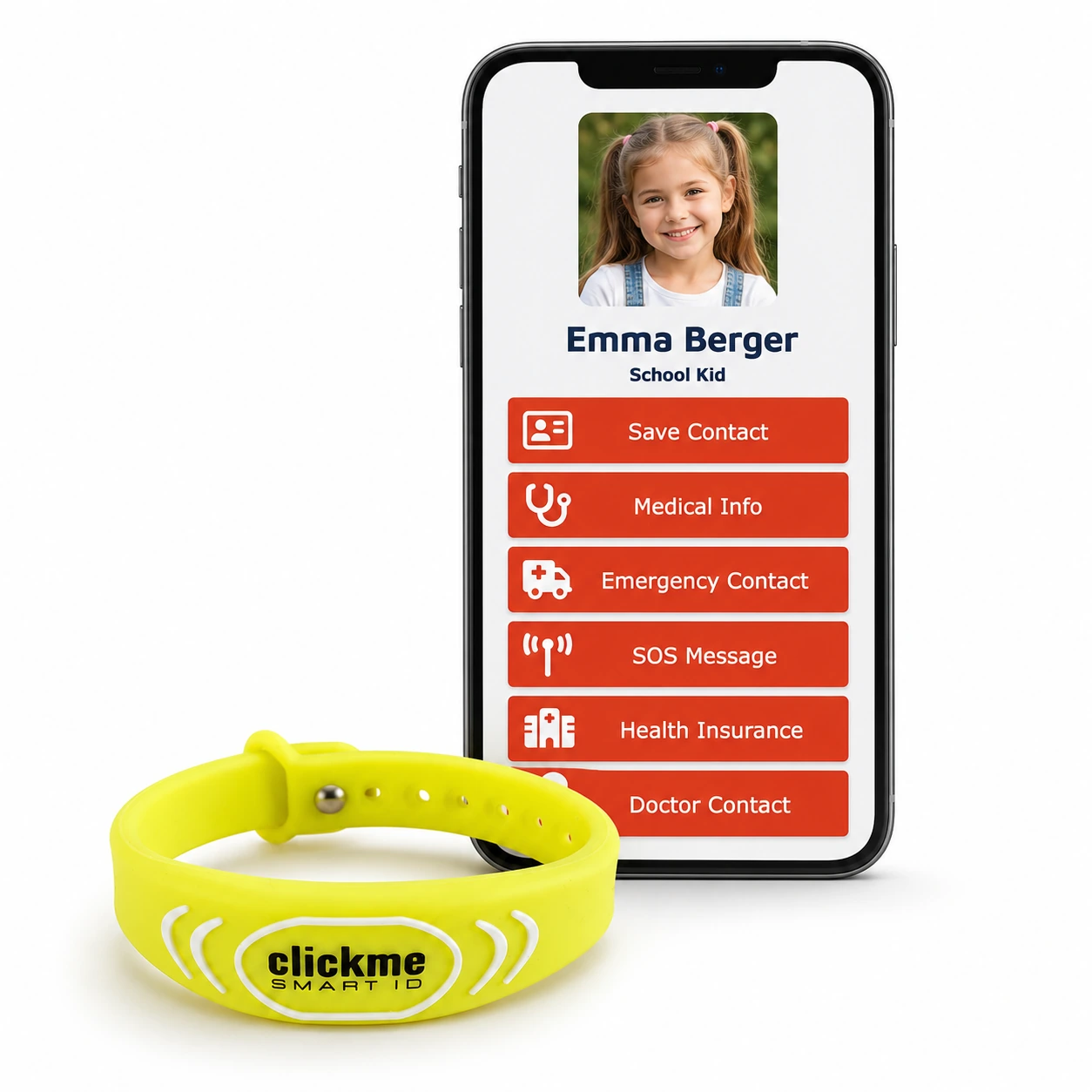
Every field in the ClickMe SOS profile is optional. Parents decide what information they consider appropriate to share.
The profile can include:
The profile is not limited to medical data. Its primary purpose may simply be to help identify the child and allow someone to call the pare
Parents should review the information regularly. Phone numbers, medication and emergency instructions should always remain accurate.
For privacy reasons, only information that may genuinely help in an emergency should be added. It is usually unnecessary to publish large amounts of personal data.
As children grow, they gradually become more independent. They may travel to school, visit friends, attend sports sessions or ride around the neighbourhood without a parent standing next to them.
This independence is an important part of childhood. However, it also means that parents cannot be physically present during every unexpected event.
An SOS bracelet does not monitor the child or prevent an accident. Instead, it provides a simple bridge between the child, the person offering help and the family.
It can be especially useful during:
The same bracelet can therefore support more than scooter safety. It can also help when a child becomes lost, frightened or separated from their family.
An NFC emergency bracelet is an additional safety measure. It does not replace accident prevention.
Children should use an approved, correctly fitted helmet whenever they ride a scooter or bicycle. They should also wear visible clothing and use appropriate protective equipment.
The CPSC recommends checking the scooter’s brakes, handlebars, tyres and frame before riding. It also advises riders to watch for obstacles, keep both hands on the handlebars and avoid carrying a second per
Parents should also consider the child’s age, experience and local traffic rules. Electric scooters can reach much higher speeds than traditional kick scooters and may be subject to legal age restrictions.
The ClickMe SOS NFC ID Bracelet does not replace:
It is a practical safety add-on designed to make identification and parent contact eas
Most scooter rides end without a problem. However, accidents are unpredictable. Parents cannot know when a child might fall, become confused or need help from a stranger.
A visible emergency ID bracelet gives the child a way to carry essential contact information without carrying paperwork or a phone.
The ClickMe SOS NFC ID Bracelet for Kids provides NFC and QR access to an editable online profile. It can help another person identify the child, contact the parents and view optional emergency notes when every minute feels important.
Scooter and e-scooter injuries among children have increased considerably. US safety data show that children aged 14 and younger are disproportionately represented in micromobility injuries. Recent specialist hospital data from Ireland also show a sharp rise in serious e-scooter-related brain injur
No. An SOS bracelet cannot prevent an accident. It can help identify the child, provide emergency contact details and make optional safety information available after an incident.
No. A person providing assistance can scan the QR code or tap the NFC chip using their own compatible smartphone. The SOS profile opens in a web browser without a special
Parents can add emergency contacts, allergies, medical conditions, medication notes and special instructions. All fields are optional, and the profile can be updated onl
No. The bracelet is an additional child safety tool. It does not replace an official medical ID, professional medical advice, emergency procedures or proper supervision.
No. It can also be useful at school, during sports, on playgrounds, while travelling, at camps and in crowded public places.
Check the Clickme Smart SOS Wristband for kids