Italian hospitality has always been built on something deeper than convenience. The best pizzerias and restaurants are not simply places to eat. They are places where craft, rhythm, family tradition, and identity come together. In Italy especially, pizza is still closely tied to artisanal culture and local reputation, with a sector that remains strongly rooted in traditional business models and family-run operations. At the same time, competition is intense, and the market is moving toward stronger differentiation based on quality, experience, and positioning. (FIPE)
That is exactly why more Italian pizzerias and Italian restaurants, both in Italy and abroad, are choosing ClickMe Google Review Displays and Tripadvisor Review Displays.
They are not abandoning tradition. They are protecting it, while making it easier for modern guests to discover, trust, and choose them.
Recent sector analysis shows that Italy’s pizza market is no longer driven by price alone. It is increasingly shaped by quality, experience, and differentiation, and one report summarizing 2025 market data says that 80% of customers choose a pizzeria primarily for quality. The same analysis highlights a more premium, more segmented market, where operators are under pressure to define what makes them stand out. (sial-network.com)
That fits exactly with what the best pizzerias already know.
Guests care about dough, ingredients, fermentation, consistency, service, atmosphere, and authenticity. But before they experience any of that in person, they often encounter the restaurant online first. On Google Maps, Google Search, and Tripadvisor, the first signals they see are usually:
This matters because the restaurant that looks more trusted often gets the first click, the first walk-in, or the first booking.
A lot of restaurant owners focus mainly on average rating. Rating matters, of course, but review quantity matters too.
That is not just intuition. Tripadvisor explains that its Popularity Ranking is based on the quality, recency, and quantity of reviews, and that these factors work together over time. Tripadvisor also states that, all else being equal, a business with more strong reviews will rank better than one with fewer. (Tripadvisor)
Academic research in the restaurant sector points in the same direction. A study on U.S. casual dining brands found that review volume was positively associated with customer share of visits, meaning that the number of reviews was linked to how much customer traffic brands captured. (MDPI)
And broader local consumer review research from 2026 shows why this makes intuitive sense in real buying behavior:
So yes, quality matters. But volume also changes perception.
If one pizzeria has 70 Google reviews and another nearby has 300, many people will assume the second place is more established, more frequently visited, and more trusted, even before they read a single comment. That is exactly how social proof works, and in competitive restaurant streets, tourist zones, and delivery-heavy neighborhoods, that perception can be decisive. The same BrightLocal study notes that review count itself signals credibility and reduces perceived risk for potential customers. (BrightLocal)
Tripadvisor has stated that over 90% of diners say restaurant reviews matter when choosing a place to eat. That is especially important for pizzerias and Italian restaurants, because they often attract both locals and visitors making quick decisions based on reputation, convenience, and trust. (MediaRoom)
For tourist-facing venues, Tripadvisor is particularly important because it remains one of the most familiar restaurant discovery platforms for travelers. For local search visibility, Google is the obvious anchor because reviews appear directly on the Business Profile in Maps and Search, where people make fast restaurant decisions. Google explicitly says reviews can help a business stand out and provide helpful information to potential customers. (Google Hilfe)
So for an Italian restaurant, using both Google and Tripadvisor is not overkill. It is strategic.
Google helps capture local intent and map-based discovery. Tripadvisor helps capture travel intent and destination-driven dining choices. Together, they create stronger digital trust.
One of the biggest realities in pizzerias and restaurants is speed.
Italian pizza businesses are still largely artisanal and operationally lean. FIPE-backed research shows that 74.3% are family-run, 76% operate from a single location, and the average site employs around 14 staff members. Sector reporting also shows that 72% of activity is concentrated on weekends and 87% of peak demand happens at lunch and dinner. In other words, these are exactly the kinds of businesses where service is intense, time is limited, and staff cannot spend the evening chasing reviews manually. (FIPE)
That is why review collection only works when it is simple.
Google officially recommends making reviews easier to leave by sharing a link or QR code, and specifically suggests that businesses print and display the QR code in-store. Google also says customers can be asked to leave reviews by scanning a QR code. (Google Hilfe)
This is precisely where ClickMe review displays make sense.
A guest who has just enjoyed the pizza, the wine, the tiramisu, or the service does not want homework. They do not want to search for the business name, scroll through listings, and hope they found the right profile. The easier the path, the more likely the review happens.
A premium NFC and QR review display removes friction at the exact moment satisfaction is highest.
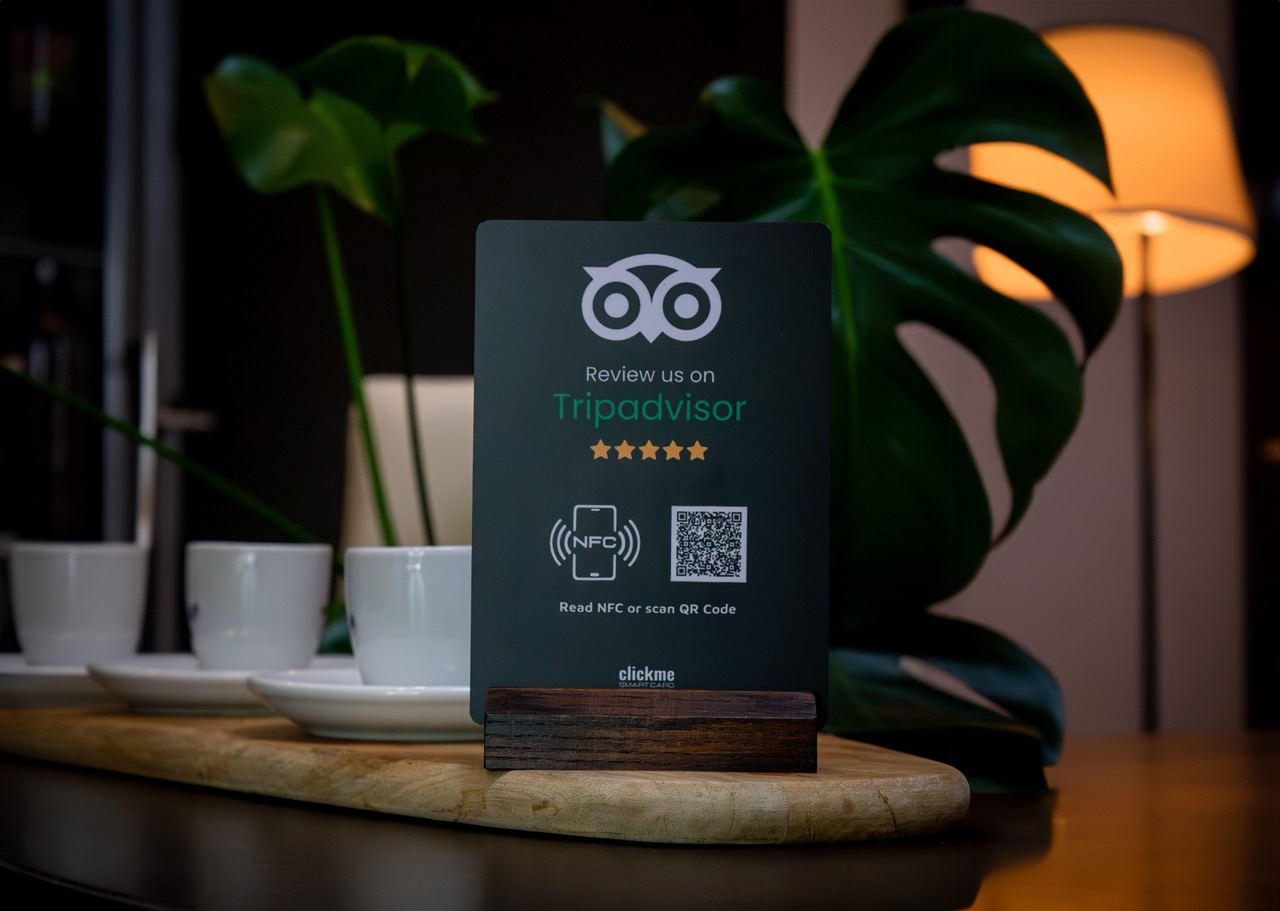
A handcrafted pizzeria, a refined trattoria, or a stylish modern Italian restaurant works hard to create a certain atmosphere. Tables, materials, plating, interior design, lighting, and presentation all communicate quality. A cheap, mass-produced plastic review stand can interrupt that experience rather than support it.
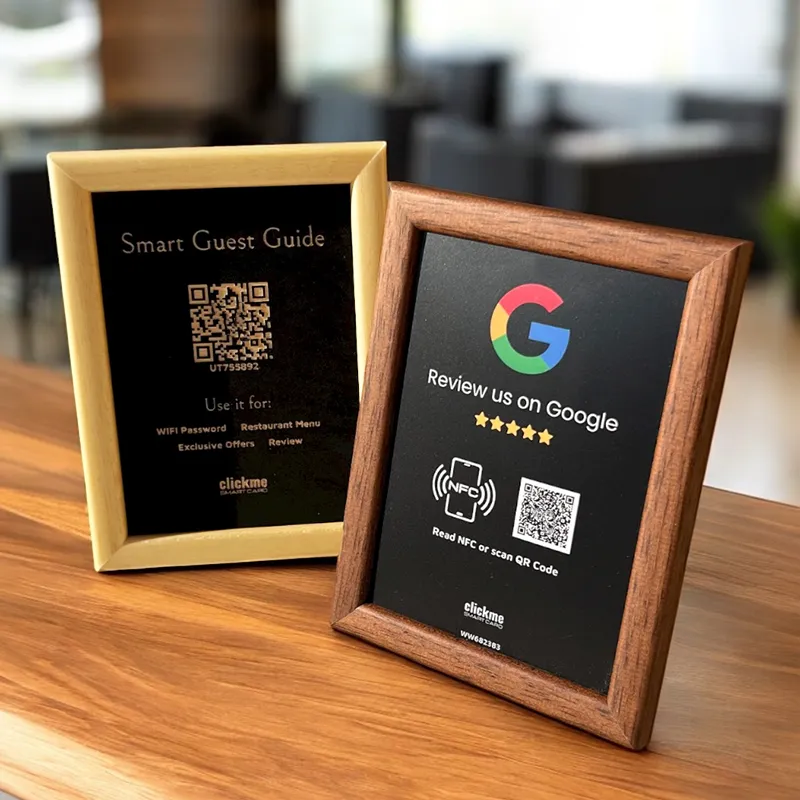
ClickMe review displays are designed as premium hospitality tools, not as throwaway accessories. We use high-quality wood craftsmanship and durable PVC-based NFC displays, instead of the generic low-end plastic products that dominate online marketplaces. For restaurants that care about presentation, that difference is not cosmetic. It is part of brand consistency.
If a restaurant invests in artisanal pizza, premium ingredients, service flow, table styling, and interior character, the review touchpoint should feel like it belongs in that same environment.

Restaurants do not only choose ClickMe because the displays look better.
They also choose ClickMe because the system behind them is not generic.
We do not simply resell a tag or print a QR code. We manufacture the products, and we also develop and operate the software ourselves. That matters because restaurants are not just buying a piece of material for the table. They are buying a reliable review collection tool that needs to work consistently, look premium, and support real business goals.
ClickMe has been developing and operating its own system for six years, and today our solutions are used across nearly every country in Europe by businesses that want a more modern and more effective way to collect reviews and strengthen their online presence.
For pizzerias and restaurants, that means:
For restaurants in city centers, destination towns, holiday regions, and international neighborhoods, reputation is even more exposed.
A traveler usually has less context than a local. They often do not know which restaurant has been great for ten years and which one opened recently. They use shortcuts:
That is why Tripadvisor’s ranking logic matters so much. Tripadvisor explicitly says its ranking is influenced by quality, recency, and quantity, and that a large number of recent reviews carries more weight than older ones. (Tripadvisor)
So for a tourist-heavy restaurant, review collection is not just about reputation display. It is about keeping the listing fresh, active, and competitive.
One of the most important lessons from current review behavior research is that review generation should be ongoing.
Consumers increasingly look for recent proof, not just historic proof. BrightLocal’s 2026 survey found that 74% seek reviews written in the last three months, and 44% say a review posted within the last month is an important trust factor. (BrightLocal)
That means restaurants should not think in terms of “we already have enough reviews.”
They should think in terms of momentum.
A pizzeria that collects reviews week after week sends a stronger signal than a pizzeria that collected many reviews two years ago and then went quiet.
This is another reason physical review displays work so well in restaurants. They are always present, always visible, and always ready at the point of experience. They turn review collection into a natural part of service, not a separate admin task.
There is one more reason professional restaurants prefer a proper review collection system: trust.
Google’s official guidance says reviews must reflect a genuine experience, and offering incentives such as discounts, free items, or rewards in exchange for reviews is strictly prohibited. Tripadvisor has the same position and prohibits incentivized reviews connected to any promised benefit. (Google Hilfe)
That is exactly why the right approach is not to manipulate reviews. It is to make it easy for real guests to leave honest feedback.
ClickMe helps restaurants do that in a clean, fast, policy-aligned way.
The best Italian pizzerias do not win because they are trendy.
They win because they are memorable, consistent, and trusted.
But in 2026, trust is built both offline and online. The dough, the oven, the ingredients, and the hospitality still matter most. Yet the number of reviews, the freshness of feedback, and the ease with which satisfied guests can share their experience now shape who gets discovered next.
That is why more Italian pizzerias and restaurants choose ClickMe Google Review and Tripadvisor Review Displays.
Because they want a review solution that is:
For restaurants that care about quality, presentation, and efficiency, a premium review display is not a gimmick.
It is part of the guest journey.
Google reviews appear directly on a business’s profile in Search and Maps, and Google says reviews can help a business stand out while giving potential customers helpful information. (Google Hilfe)
Both matter. Tripadvisor says its ranking uses quality, recency, and quantity of reviews, and consumer research shows many people hesitate to choose businesses with very low review counts. Restaurant-sector research has also linked review volume to customer share of visits. (Tripadvisor)
Google is critical for local discovery in Search and Maps, while Tripadvisor remains highly relevant for travelers and restaurant choice during trips. Tripadvisor has also said that over 90% of diners say restaurant reviews matter when choosing where to eat. (Google Hilfe)
Yes. Google explicitly recommends using a review link or QR code and says businesses can print and display the QR code in-store to make reviews easier to leave. (Google Hilfe)
No. Google prohibits incentives in exchange for reviews, and Tripadvisor also prohibits incentivized reviews connected to promised benefits. (Google Hilfe)
Choose a review solution that reflects the quality of your restaurant — click here to explore our premium ClickMe review displays.