Restaurants rarely need to remind a disappointed guest that Google Reviews exists. When someone wants to complain, they are usually motivated enough to search for the business, find the correct listing and share their experience.
Happy guests behave differently.
They finish their meal, thank the team, pay the bill and continue with their day. Many would gladly recommend the restaurant, but the moment passes. By the time they remember, opening Google, finding the right location and writing a review feels like one task too many.
This gap between a positive experience and a public review was the practical challenge behind the SI Restaurant project.
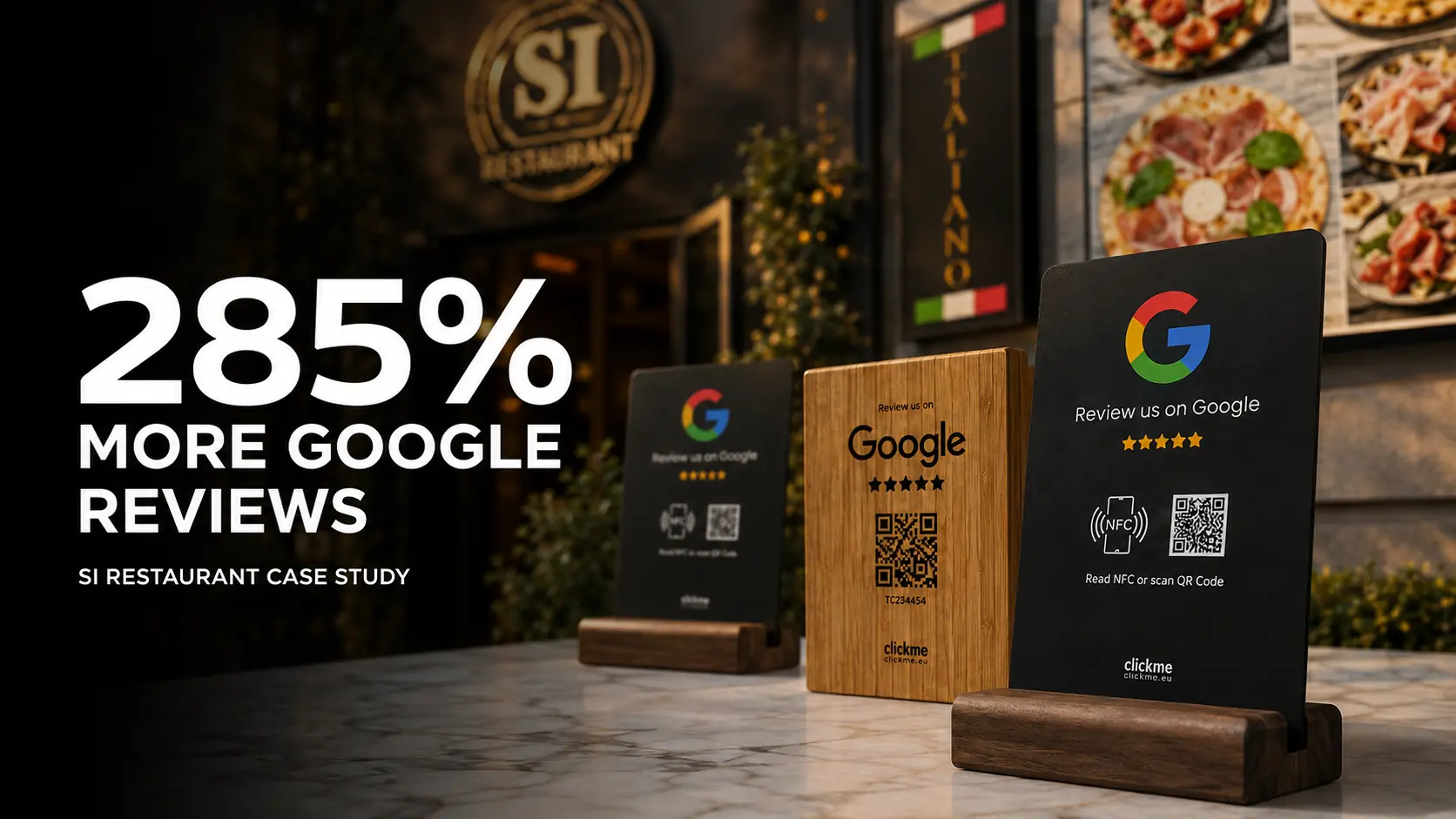
In the last week of May 2026, ClickMe supplied SI Restaurant in central Budapest with tabletop Google Review Displays. Each display gave guests two immediate routes to the restaurant’s review form:
No app was required. Guests did not have to type the restaurant’s name or choose between similar listings. The next step was already available at the table, while the food, service and atmosphere were still fresh in their minds.
The change in review activity was substantial.
| Metric | Before the displays | After the displays |
|---|---|---|
| Measurement period | January–May 2026 | June–July 2026 |
| Estimated monthly average | 15.2 reviews | 58.5 reviews |
| Relative review rate | 1× | 3.85× |
| Estimated increase | — | +285% |
June was the first complete month with the ClickMe displays in place. July then recorded an even stronger result.
| Month | Estimated new reviews | Difference from the pre-installation monthly average |
| June 2026 | 40 | +163% |
| July 2026 | 77 | +407% |
| 1–6 August 2026 | 12 | Partial month |
Across June and July, SI Restaurant received an estimated 117 new Google ratings. That works out at 58.5 per month, compared with 15.2 per month between January and May.
The early August pace was also notable: 12 ratings in six days, or roughly two per day. A simple continuation of that pace would put the month near 60 new reviews.
To avoid relying only on a quiet early-2026 baseline, we also estimated SI Restaurant’s review activity for the full 2025 calendar year.
The restaurant received approximately 370 Google ratings in 2025, equal to an average of about 30.8 per month. The post-installation rate of 58.5 per month was therefore:
This wider comparison matters. Restaurant traffic is seasonal, and no before-and-after analysis can remove every outside influence. Even with a stronger historical benchmark, however, the review activity after installation remained clearly elevated.
One concern regularly stops restaurant owners from making review access more visible:
“If we put a Google review sign in front of every guest, will we simply attract more negative feedback?”
The SI Restaurant data does not support that fear.
The recent review set analysed for this case study had an average score of 4.71 out of 5. SI Restaurant’s lifetime Google rating stood at 4.5.
Among 227 recent, non-edited ratings included in the analysis:
| Rating | Number | Share |
| 5 stars | 197 | 86.8% |
| 4 stars | 15 | 6.6% |
| 3 stars | 3 | 1.3% |
| 2 stars | 3 | 1.3% |
| 1 star | 9 | 4.0% |
Almost 87% of the ratings were five-star reviews. The estimated average for the June-to-early-August period was approximately 4.8, although month-level scores should be treated as directional because Google displays relative rather than exact publication dates.
In other words, increasing the visibility of the review option did not dilute review quality. Recent guests rated the restaurant more highly, on average, than its full historical profile.
A review display does not create satisfaction. The food, service and hospitality must do that first.
What the display changes is the amount of effort required to express that satisfaction.
An unhappy customer already has a reason to act. A satisfied customer often needs a convenient prompt. When the review form is one tap or scan away, more of the positive experiences that already exist inside the restaurant can become visible online.
This is not review filtering or “review gating”. The ClickMe display opens the same public Google review interface for every guest. It does not select a star rating, block criticism or reward positive feedback. The guest remains free to leave an honest opinion.
The system simply removes three common points of friction:
For a busy restaurant, that small reduction in effort can affect how many real guest experiences become part of its online reputation.
A restaurant table is different from a follow-up email or a social media post. It is part of the actual service experience.
The display can be visible when:
At these moments, the request feels relevant rather than intrusive. The guest can act immediately from their own phone, without handing over personal information or installing software.
The physical design also matters. A stable tabletop display with a wooden base looks intentional and can fit naturally into a restaurant interior. It is easier to notice than a small sticker, more durable than a printed sheet of paper and always available when staff members are too busy to ask verbally.
The SI Restaurant project offers four practical lessons.
A 4.5 rating may look strong, but the frequency of new reviews tells customers whether the profile reflects the restaurant today. Track reviews per week or month before and after changing the guest journey.
A review request works best when it appears close to the experience. For restaurants, that usually means tables, the payment point, a reception desk or the takeaway counter.
NFC is fast and intuitive on compatible phones. QR provides a familiar alternative and works through the camera on virtually any modern smartphone. Offering both avoids unnecessary technical friction.
The purpose of a review display is to make feedback easier, not to manipulate it. Do not offer rewards for positive ratings or direct only happy customers to Google. Invite genuine reviews and use critical feedback to improve the operation.
The timing and scale of the increase show a strong association between the installation of the displays and higher Google review activity. They do not prove that every additional rating came from the displays alone.
Visitor volume, Budapest’s summer tourism, staff engagement and other operational factors may also have contributed. The Google interface provides relative dates such as “two weeks ago” or “three months ago”, so calendar-month counts are estimates rather than an export of exact timestamps.
Even with those limitations, the pattern is commercially meaningful: review volume rose sharply after the tabletop prompts appeared, stayed high through the next two full months and did so without lowering the average rating.
Guests cannot review an experience they did not enjoy. But even an excellent experience may remain invisible if leaving feedback requires too many steps.
A ClickMe Google Review Display places the action at the right moment and reduces it to one tap or scan. The result is a simple bridge between good hospitality at the table and the reputation future guests see online.
Explore the ClickMe NFC and QR Google Review Table Display.
This case study uses SI Restaurant’s public Google Maps review list as observed on 6 August 2026. Google displays relative review ages rather than exact calendar dates, so monthly figures were estimated by allocating visible age groups proportionally across the calendar periods they cover. Reviews showing only an edit date were excluded from new-review counts. The August projection is a simple linear estimate based on the first six days of the month. Older reviews displayed as “one year ago” were distributed proportionally across their 12-month range for the 2025 benchmark. Figures should therefore be read as directional estimates, not Google Business Profile export data.