When people have several businesses to choose from, they rarely analyse every option from scratch. Instead, they look for signals that make the decision easier.
Which business looks established? Which one seems trustworthy? Where do other people go? Which company already has hundreds of satisfied customers?
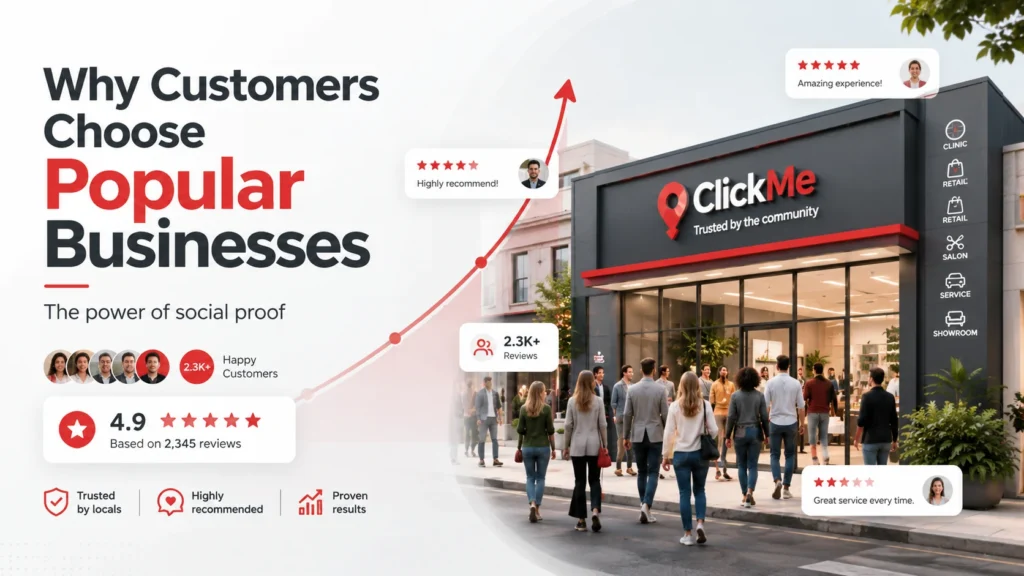
This behaviour is closely connected to a psychological principle called social proof — and understanding it can give almost any location-based business a significant marketing advantage.
Whether you run a retail store, dental clinic, beauty salon, gym, car dealership, repair shop, showroom, medical practice, real estate office or another local business, social proof can influence whether a potential customer chooses you or the competitor down the street.
What is social proof?
Social proof is the tendency to look at the behaviour and decisions of other people when we are uncertain about what to do ourselves.
The principle was popularised by psychologist and author Dr. Robert Cialdini in his work on persuasion and influence. Cialdini explains that especially in situations of uncertainty, people tend to use the actions of others as a guide for their own decisions.
In simple terms:
If many other people have already chosen something, we are more likely to believe that it is a good choice.
This happens constantly in everyday life.
- A busy shop can feel more attractive than an empty one.
- A long queue can make a product appear desirable.
- A service provider recommended by several friends immediately feels safer.
- A clinic with hundreds of positive reviews may appear more established than one with only a handful.
- A product labelled “best seller” can become more attractive simply because many others have chosen it.
None of these signals necessarily guarantees that something is objectively better. What they do is reduce uncertainty.
And reducing uncertainty is extremely important in customer acquisition.
Why do customers follow the choices of other people?
Imagine that you need a service in a city you do not know.
You search Google and find two similar businesses.
Business A: 4.7 stars from 286 reviews
Business B: 4.7 stars from 14 reviews
The average rating is exactly the same.
Yet Business A will often feel like the safer choice.
Why?
Because 286 reviews communicate something beyond the star rating itself:
Hundreds of people have already made this decision before you.
That creates reassurance.
You are no longer taking a completely unknown risk. Other customers have effectively tested the business first.
Customers are not only looking for the best business — they are trying to avoid a bad decision
This is an important distinction.
When businesses think about marketing, they usually focus on explaining why they are better:
- better quality,
- better service,
- better prices,
- more experience,
- better technology.
But from the customer's perspective, the question is often slightly different:
“How do I know I will not regret choosing this company?”
This is particularly important when the customer has never used the business before.
A professional website can help. Good branding can help. Advertising can help.
But all of these messages come from the business itself.
Social proof is different because the evidence comes from other customers.
Instead of the company saying:
“You can trust us.”
the market is effectively saying:
“Many people have already trusted them.”
That is a much more powerful message.
What does research say about reviews and customer decisions?
Online reviews have turned social proof into something that customers can measure almost instantly.
BrightLocal's 2026 Local Consumer Review Survey found that:
- 85% of consumers are more likely to use a business after reading positive reviews.
- 92% care about star ratings when choosing a business.
- 47% would not use a business with fewer than 20 reviews.
- 74% look for reviews written within the previous three months.
- 93% have made a purchase after reading reviews.
These findings highlight an important point: having a good rating is not the only factor customers notice.
Review quantity and recency also contribute to perceived credibility.
A business with a 4.8 rating and 400 recent reviews can create a very different first impression from a business with the same 4.8 rating but only eight reviews.
Source: BrightLocal Local Consumer Review Survey 2026.
Reviews can even affect how much customers are willing to pay
The economic value of social proof is not limited to getting attention.
A 2025 Euroconsumers study involving 4,200 adults across Belgium, Italy, Portugal and Spain examined how online reviews affect purchasing decisions.
More than three quarters of respondents — 78% — said customer reviews played an important role in their buying decisions.
The researchers also conducted behavioural experiments and found evidence that consumers assigned measurable economic value to reliable review information.
In the experiments, consumers were willing to pay approximately 5–7% more for products supported by verified reviews compared with otherwise less-supported alternatives.
This does not mean every business can simply increase its prices by 7% after collecting reviews. But it demonstrates something important:
Trust has economic value.
When customers feel more confident about a decision, price is no longer the only factor they evaluate.
Source: Euroconsumers – The Economic Value of Online Reviews, 2025.
Social proof can create a growth loop
For local businesses, social proof can become particularly powerful because it can reinforce itself over time.
The process can look like this:
More customers → more reviews → stronger social proof → more trust → more new customers → more reviews
This creates a type of reputation flywheel.
One customer may initially choose you because of your location. Another may come because of an advertisement.
But if those customers leave visible feedback, their experiences can help convince future customers who have never interacted with your business before.
Your existing customers effectively help reduce the perceived risk for your future customers.
Where can a local business use social proof?
Google reviews are one of the most visible forms of social proof, but they are not the only one.
Businesses can demonstrate genuine customer confidence in several ways:
- Google reviews and star ratings,
- customer testimonials,
- case studies,
- before-and-after results,
- customer numbers,
- “most popular” products or services,
- real customer photos,
- recognisable client logos,
- industry certifications,
- social media comments and interactions,
- real examples of completed projects.
The key word is genuine.
Social proof works because customers believe it represents real experiences. Fabricated testimonials, purchased reviews or manipulated ratings undermine exactly the trust the strategy is supposed to create.
Why are Google reviews especially valuable for location-based businesses?
For a physical or local business, Google reviews have one major advantage:
customers often see them at the exact moment they are deciding where to go.
Someone searching for:
- a dentist nearby,
- a tyre shop,
- a beauty salon,
- a gym,
- a furniture showroom,
- a car dealership,
- a repair service,
- a local retailer,
- or almost any other local service
may see the rating and total number of reviews directly in Google Search or Google Maps before they ever visit the company's website.
Google itself states that review count and positive ratings can contribute to a business's local search ranking.
So reviews can potentially help a business in two different ways:
- Visibility: stronger review signals can contribute to local Google performance.
- Conversion: once customers see the business, strong social proof can make them more comfortable choosing it.
This is why Google reviews should not be treated simply as a reputation score.
For many location-based businesses, they are part of the customer acquisition system.
You can read more about this connection in our guide on how Google reviews are increasingly relevant to AI-powered business recommendations.
Why review quantity matters more than many businesses realise
Consider these two profiles again:
Business A — ★ 4.8 — 412 reviews
Business B — ★ 4.8 — 23 reviews
Both businesses have excellent ratings.
But the first profile contains much stronger social proof.
The number 412 communicates:
- many customers have already visited,
- the business has an established track record,
- the rating is based on a larger sample of experiences,
- choosing the company may therefore feel less risky.
This is one reason businesses should not stop collecting reviews simply because they already have a good rating.
Social proof is cumulative.
Recent social proof is stronger than historical social proof
Imagine finding a business with 300 reviews — but almost all of them are three or four years old.
You may immediately wonder:
- Is the business still as good?
- Has the management changed?
- Are the same employees still there?
- Has the service quality declined?
This helps explain why the BrightLocal study found that 74% of respondents look for reviews written within the previous three months.
A successful review strategy therefore should not be a one-time campaign.
It should be an ongoing process.
The hidden problem: many happy customers never leave a review
This is where many businesses lose valuable social proof.
A satisfied customer completes a purchase.
They are happy.
They leave.
And nothing happens.
It is not necessarily because they do not want to recommend the business.
They simply continue with their day.
Later, leaving a review requires them to:
- remember to do it,
- search for the business,
- find the correct Google profile,
- open the review section,
- and finally write the review.
Every additional step creates friction.
And friction reduces action.
What happens when you make leaving a review easier?
One of the simplest ways to collect more genuine customer feedback is therefore not necessarily to persuade customers harder.
It is to make the process easier.
Instead of asking customers to remember your business hours later, you can give them access to the review page while they are still physically present.
That was the idea behind a recent ClickMe customer case study.
A real example: review activity increased from 15.2 to 58.5 reviews per month
In the final week of May 2026, SI Restaurant in Budapest introduced ClickMe NFC and QR Google Review Displays at its tables.
Before installation, between January and May 2026, the restaurant received an estimated average of 15.2 new Google reviews per month.
During the first two complete months after installation — June and July — the estimated average increased to 58.5 reviews per month.
That represents approximately a 3.85× review rate, or a 285% increase compared with the pre-installation monthly average.
This is a before-and-after business case rather than a controlled scientific experiment, so the change cannot be attributed exclusively to one factor. However, it demonstrates what can happen when businesses remove friction and make the review opportunity visible at the point of customer interaction.
And the principle is not limited to restaurants.
The same approach can be used anywhere customers physically interact with a business:
- at a checkout counter,
- at a reception desk,
- in a showroom,
- at a beauty salon mirror,
- at a clinic reception,
- at a gym desk,
- inside a repair workshop,
- at a dealership,
- or wherever a successful customer experience ends.
Turn customer satisfaction into visible social proof
Every satisfied customer has potential marketing value beyond their original purchase.
If their positive experience remains private, only that customer knows about it.
If they share their experience publicly, it can influence hundreds or thousands of future customers.
This is why review collection should not be seen simply as asking customers for a favour.
It is a way of turning customer satisfaction into visible evidence of trust.
Make the next step effortless with NFC and QR
The ClickMe Google Review NFC and QR Code Display is designed to create this connection between the physical customer experience and your online reputation.
Place the display at the point where customers naturally finish their interaction with your business.
Then they can:
- tap the display with an NFC-enabled smartphone, or
- scan the QR code with their camera.
The business's Google review page opens directly.
No searching for the company.
No typing the business name.
No app installation.
No complicated instructions.
Just a much shorter path between:
“I had a good experience”
and
“I shared my experience.”
For businesses that need a portable option instead, the ClickMe Google Review Card provides the same NFC and QR functionality in card format.
You can also browse all available ClickMe Review Cards and Review Displays.
Ask for reviews ethically
A strong reputation is valuable only when customers can trust it.
Businesses should therefore ask for honest reviews from genuine customers, rather than attempting to manufacture positive ratings.
The goal should not be:
“How can we manufacture a perfect rating?”
It should be:
“How can we make it easier for real customers to share their real experiences?”
That creates sustainable social proof rather than artificial reputation.
The businesses people choose today influence the businesses people choose tomorrow
Social proof explains something fundamental about customer behaviour.
People do not make decisions in isolation.
They look at what others have already done.
If hundreds of people have visited a business, recommended it and publicly shared positive experiences, choosing that business feels easier and safer.
That means every satisfied customer can help influence the next customer.
And every new review adds another visible piece of evidence:
People choose this business.
The more consistently you turn real customer satisfaction into visible social proof, the easier it can become for the next customer to choose you too.
Discover the ClickMe Google Review NFC & QR Display →
Frequently Asked Questions
What is social proof in marketing?
Social proof is the tendency for people to use the behaviour, opinions and experiences of others to help make their own decisions. In marketing, examples include customer reviews, testimonials, ratings, case studies, customer numbers and popular product labels.
Why does social proof help businesses get more customers?
Social proof reduces uncertainty. When potential customers see that many other people have already chosen and positively reviewed a business, the decision can feel safer and less risky.
Do Google reviews influence customer decisions?
Yes. BrightLocal's 2026 Local Consumer Review Survey found that 85% of respondents were more likely to use a business after reading positive reviews, while 92% said star ratings matter when choosing a business.
Does the number of Google reviews matter?
Review volume can act as an important credibility signal. In BrightLocal's 2026 survey, 47% of respondents said they would not use a business with fewer than 20 reviews. A larger body of genuine reviews can provide stronger social proof than a similar rating based on only a few customer experiences.
Do recent Google reviews matter?
Yes. Customers often want evidence that reflects the business today. BrightLocal found that 74% of respondents were interested in reviews written within the previous three months.
Can Google reviews improve local search visibility?
Google states that review count and positive ratings can contribute to local search ranking. Reviews are only one part of local ranking, alongside factors such as relevance, distance and prominence.
How can a business get more Google reviews?
Ask genuine customers for honest feedback and remove unnecessary steps from the process. A direct Google review link, NFC review card or QR review display can help customers open the review page immediately instead of searching for the business manually.
What is an NFC Google Review Display?
An NFC Google Review Display is a physical sign containing an NFC chip and typically a QR code. Customers tap or scan the display with their smartphone and are taken directly to the business's Google review page.