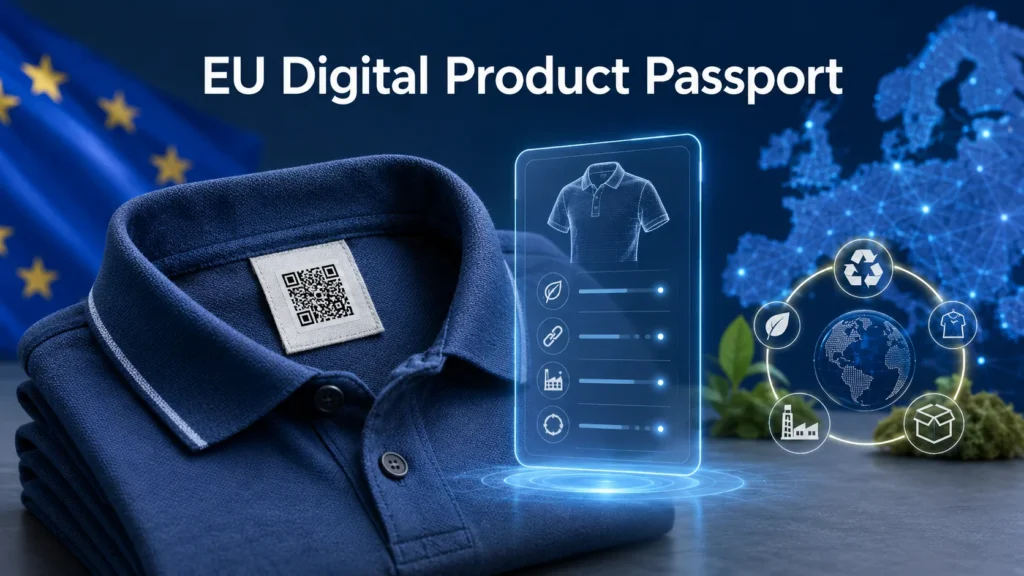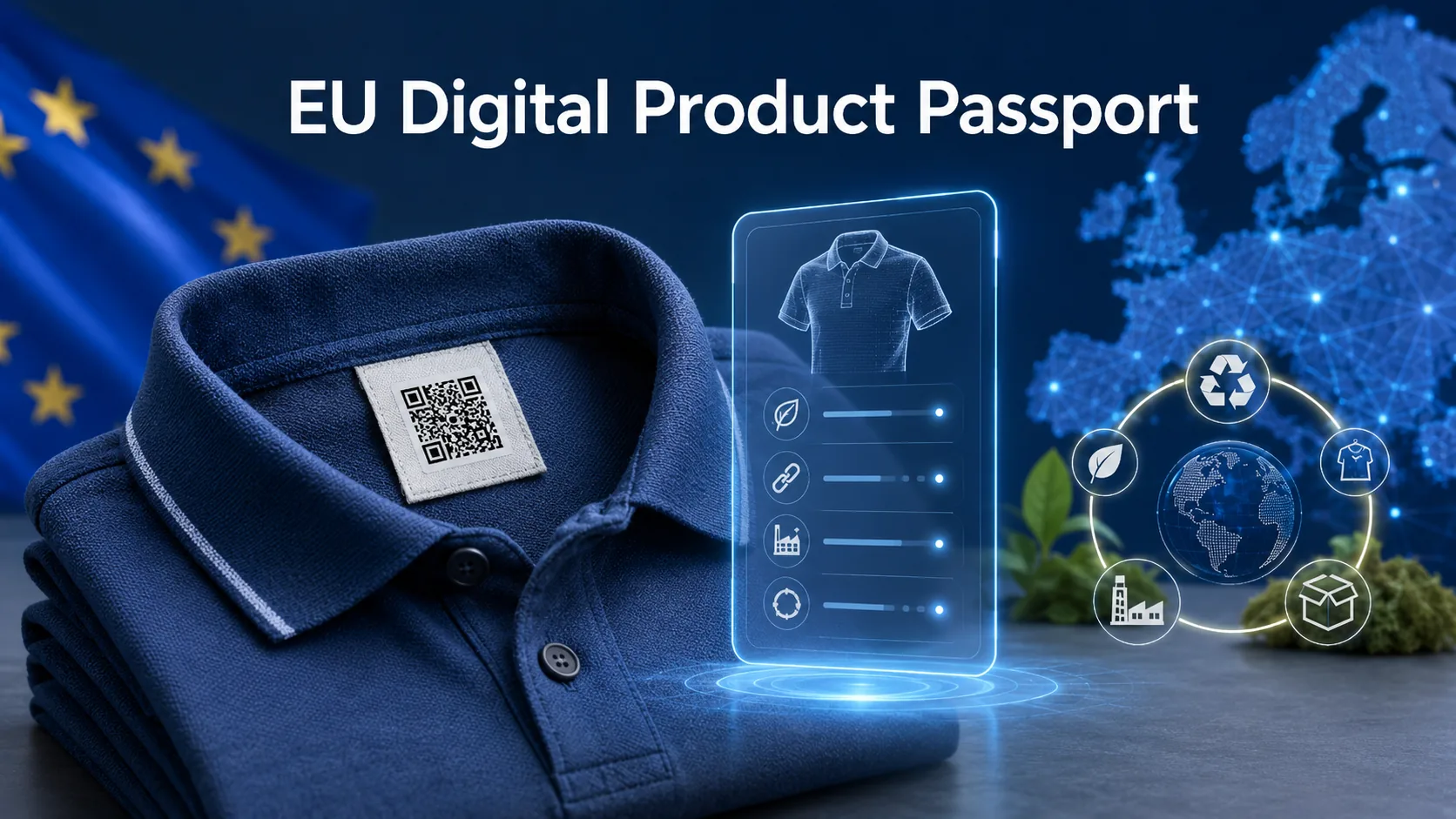
The EU Digital Product Passport (DPP) is becoming one of the most important new product compliance systems in the European Union. It will connect physical products with structured digital information about their identity, materials, origin, sustainability, repairability, compliance and lifecycle.
The system is no longer just a future concept. The European Union's central Digital Product Passport Registry became operational on 20 July 2026, technical standards are being introduced, and the first major mandatory Digital Product Passports will apply to certain batteries from 18 February 2027.
However, there is no single date on which every product sold in Europe suddenly needs a Digital Product Passport. The EU is introducing DPP requirements progressively and product-specific legislation will determine exactly which products need a passport, what information must be included and when the obligation starts.
This guide explains how the EU Digital Product Passport works, which companies will be affected, the key dates businesses should know and how manufacturers and importers can start preparing.
A Digital Product Passport is a structured digital record connected to a physical product through a persistent unique product identifier. Users can access the relevant information through a data carrier such as a QR code or another supported identification technology.
The passport is designed to improve product traceability, transparency, sustainability and regulatory compliance throughout the product lifecycle.
Depending on the product category, a DPP may contain information about:
The exact data requirements will not be identical for every product. They will be defined by the EU legislation applicable to each product group.
The Digital Product Passport is part of the EU's transition towards a more circular economy. Today, important product information is often fragmented across manufacturers, suppliers, ERP systems, certificates, PDF documents and databases.
The DPP aims to make relevant information available in a standardised and machine-readable format throughout the value chain.
This can help consumers make more informed purchasing decisions while giving manufacturers, importers, distributors, repair companies, recyclers, customs authorities and market surveillance authorities access to the information relevant to their role.
The system is also designed to support more efficient reuse, repair, refurbishment and recycling of products.
The main legal framework is the Ecodesign for Sustainable Products Regulation – Regulation (EU) 2024/1781, commonly known as the ESPR.
The ESPR creates the general framework for ecodesign and Digital Product Passport requirements across a wide range of physical products placed on the EU market.
However, the ESPR is primarily a framework regulation. It does not mean that every product covered by the regulation already requires a DPP.
Instead, the European Commission adopts product-specific delegated acts. These acts define the actual requirements for individual product groups.
Among other things, a product-specific act can determine:
Not for every product.
The EU Digital Product Passport is being introduced gradually. Some product groups already have legally defined requirements, while others are still undergoing regulatory preparation.
The most important distinction is between a planned date for adopting EU legislation and the date on which companies actually have to comply.
Under the ESPR, the application date of a product-specific delegated act should normally be at least 18 months after that act enters into force, unless an earlier date is justified in a particular case.
Therefore, statements such as "textiles will require a DPP in 2027" can be misleading. The EU currently plans to adopt the relevant textile rules in 2027, but the actual compliance obligation would normally follow after a transition period.
The following timeline reflects the EU rules and Commission implementation schedule available as of August 2026.
| Date | Development | What it means for businesses |
|---|---|---|
| July 2026 | DPP Registry framework and first six harmonised DPP standards | The core technical infrastructure for the EU Digital Product Passport system is established. |
| 20 July 2026 | EU Digital Product Passport Registry becomes operational | Companies can enrol organisations and use the EU Registry infrastructure. |
| September 2026 | Remaining DPP standards planned | The Commission currently expects decisions relating to the remaining two DPP standards. |
| Q4 2026 | Iron and steel DPP rules planned | The Commission plans to adopt the ESPR delegated act for iron and steel. The actual compliance date should normally follow after the transition period. |
| 18 February 2027 | Battery Passport becomes mandatory | Certain battery categories placed on the EU market must have an electronic battery passport. |
| Q2–Q3 2027 | DPP Service Provider rules planned | The Commission plans further rules defining requirements for Digital Product Passport service providers and potentially a certification framework. |
| Q2 2027 | Construction product DPP framework planned | Further rules for construction-product Digital Product Passports are expected under the Construction Products Regulation. |
| Q3–Q4 2027 | Textiles, aluminium and tyres | Product-specific ESPR delegated acts are currently planned. Actual obligations should normally follow after a transition period. |
| 2028 | Furniture | The Commission currently plans a product-specific ESPR delegated act for furniture. |
| 2029 | Mattresses and additional product requirements | Further ESPR requirements are planned, including rules relating to mattresses and recycled content. ICT products are also included in the broader ESPR roadmap. |
| 23 September 2029 | Detergents and surfactants | The new EU Detergents and Surfactants Regulation becomes generally applicable and includes Digital Product Passport obligations. |
| 1 August 2030 | Toys | The new EU Toy Safety Regulation becomes generally applicable and requires toys to have a Digital Product Passport. |
Important: dates relating to planned delegated acts are indicative regulatory milestones and should not be interpreted automatically as the date from which companies must already comply. Product-specific legislation will determine the final requirements and application dates.
Batteries are the first major product category with a fixed mandatory DPP date.
Under Regulation (EU) 2023/1542, from 18 February 2027 an electronic battery passport will be required for:
The battery passport will contain both information relating to the battery model and information specific to the individual battery.
This makes batteries one of the clearest examples of how sophisticated DPP systems can become. A passport may not simply describe a product model. It can also contain data linked to an individual physical product and information generated during its use.
The European Commission's current ESPR roadmap identifies several priority areas.
Iron and steel are among the first ESPR product groups scheduled for product-specific Digital Product Passport rules. The relevant delegated act is currently planned for the fourth quarter of 2026.
Because ESPR delegated acts normally provide at least an 18-month transition period, this does not automatically mean that all affected steel products require passports in 2026.
Textiles are one of the most widely discussed applications of the EU Digital Product Passport.
The Commission currently plans the sector-specific ESPR delegated act for textiles in Q3–Q4 2027. The legislation is expected to define which textile products are covered and which product information must be made available.
Again, 2027 is currently the planned regulatory adoption period rather than a universal DPP compliance deadline for every textile product.
The Commission currently plans delegated acts for aluminium and tyres during Q3–Q4 2027.
These sectors are particularly relevant because product traceability, material composition, recycled content and lifecycle information can play an important role in circularity and environmental performance.
Furniture is currently scheduled for an ESPR delegated act in 2028.
Possible relevant areas include durability, repairability, material identification, disassembly and recycling information, although the final mandatory data fields will be defined by the product-specific legislation.
The current Commission roadmap identifies 2029 for further requirements affecting mattresses and ICT products, together with additional horizontal requirements such as recycled-content provisions.
Construction products have their own Digital Product Passport framework under the new Construction Products Regulation, Regulation (EU) 2024/3110.
The construction-product system is intended to work together with the broader EU DPP infrastructure. Further delegated rules are currently planned for 2027.
The new Regulation (EU) 2026/405 on detergents and surfactants introduces a Digital Product Passport system for these products.
The regulation generally applies from 23 September 2029.
Manufacturers will have to create a Digital Product Passport before placing an affected detergent or end-user surfactant on the market. The passport will be connected to a persistent unique product identifier through a data carrier.
The new Toy Safety Regulation (EU) 2025/2509 also introduces Digital Product Passports.
The regulation generally applies from 1 August 2030. The DPP will contain compliance and other product information and will be accessible through a data carrier attached to the toy, its packaging or accompanying documentation.
The architecture is important because the European Union is not building one enormous central database containing every piece of information about every product.
Instead, the system uses a combination of a central EU Registry and decentralised product-data systems.
A simplified process looks like this:
Physical product → data carrier → unique product identifier → Digital Product Passport → EU DPP Registry
The manufacturer or other responsible economic operator collects the data required by the applicable legislation.
The information is structured according to the applicable data model and technical requirements.
A data carrier links the product with its persistent unique identifier and Digital Product Passport.
A QR code can be used as a data carrier in appropriate cases. Other identification technologies can also form part of DPP solutions where permitted by the applicable requirements.
Where the relevant legislation requires a Digital Product Passport, the responsible economic operator registers it in the European Commission's DPP Registry before the product is placed on the EU market.
Consumers, manufacturers, importers, distributors, repair companies, recyclers, customs authorities and market surveillance authorities may have different access rights.
A consumer does not necessarily see the same information as a customs authority or professional repairer.
The Digital Product Passport Registry is the central EU-level indexing system for Digital Product Passports.
The Registry became operational on 20 July 2026.
However, it is important to understand what the Registry does and does not do.
The EU Registry stores unique identifiers, registration information and high-level metadata required by legislation. Depending on future product-specific rules, additional information may also need to be stored there.
The complete Digital Product Passport does not necessarily have to be stored by the European Commission.
The broader DPP architecture is decentralised. Detailed product information can remain within the infrastructure of the responsible economic operator or can be hosted and managed through a Digital Product Passport Service Provider.
This architecture allows specialised technology providers to build DPP platforms that integrate product identification, product databases, APIs, lifecycle information and EU Registry connections.
Yes.
The ESPR explicitly recognises Digital Product Passport Service Providers.
A Digital Product Passport may be stored by the economic operator responsible for creating it or by a DPP service provider.
The regulation also requires the economic operator placing a covered product on the market to make a backup copy of the Digital Product Passport available through a Digital Product Passport Service Provider.
This is intended to ensure that important product information remains accessible even if the original company becomes insolvent, is liquidated or stops operating in the European Union.
The European Commission is expected to introduce more detailed requirements for DPP service providers in 2027. These rules may also include a certification scheme.
As of August 2026, the final EU-wide certification requirements for DPP service providers have therefore not yet been completed.
The ESPR already establishes several essential principles.
A Digital Product Passport must be connected through a data carrier to a persistent unique product identifier.
DPP information must use open standards and interoperable formats.
Where appropriate, information must be:
Not every Digital Product Passport will have the same level of identification.
The applicable product-specific rules can require a passport at:
For complex, high-value or long-life products, individual item-level identification may become particularly important.
The system must support different access rights for different actors in the value chain.
Relevant actors can include customers, manufacturers, importers, distributors, dealers, professional repairers, refurbishers, remanufacturers, recyclers, customs authorities and market surveillance authorities.
The DPP system must ensure the authentication, reliability and integrity of data.
This means a compliant DPP platform is considerably more sophisticated than a simple webpage opened through a QR code.
Digital Product Passports must be designed and operated with a high level of security and privacy.
The system must also prevent fraud and unauthorised manipulation.
A DPP may need to remain accessible for many years.
Under the ESPR, product-specific rules determine the required availability period, which must generally correspond to at least the expected lifetime of the product.
A backup copy must be made available through a DPP service provider where required under the ESPR framework.
This means long-term hosting, redundancy, continuity and data preservation are likely to become important components of professional DPP infrastructure.
No. A QR code is not itself a Digital Product Passport.
A QR code can act as the data carrier connecting a physical product to its persistent unique identifier and digital passport.
The DPP itself is the structured data system behind that identifier.
A compliant system may therefore include several layers:
Physical product → QR/NFC or other identifier → unique product identity → structured DPP data → access control → EU Registry integration
This distinction is important. Simply placing a QR code on a product that opens an ordinary website does not automatically create an EU-compliant Digital Product Passport.
Yes. The technical standardisation framework is now becoming concrete.
In July 2026, references to the first six harmonised Digital Product Passport standards were published at EU level.
They cover important areas including:
The Commission currently plans further standardisation decisions during 2026.
For companies developing DPP infrastructure, these standards are particularly important because new systems should be designed around interoperable European requirements rather than closed proprietary architectures.
The primary responsibility generally lies with the economic operator placing the relevant product on the EU market.
Depending on the supply chain and applicable legislation, this may be a manufacturer, importer or another responsible economic operator.
The company can use external technology and DPP service providers, but outsourcing the technical infrastructure does not automatically remove its regulatory responsibility.
The responsible company must ensure that required information is accurate, complete and up to date.
Yes.
The DPP framework is based on products being placed on the European Union market, not only on where they were manufactured.
Therefore, products manufactured in China, the United States, India or another non-EU country may still need an EU Digital Product Passport when imported into the European market if the relevant product legislation requires one.
This will make DPP compliance particularly important for European importers and distributors.
Customs enforcement is an important part of the future system.
The EU DPP Registry is designed to allow customs authorities to electronically verify whether imported products that require a passport have a valid DPP registration and whether required customs-related information has been provided.
The Registry architecture therefore connects Digital Product Passports not only with sustainability information but also with product compliance and market-access controls.
For many companies, an incorrect or missing DPP could ultimately become more than an administrative problem: it could interfere with the ability to place products legally on the EU market.
DPP obligations are also relevant to online sales.
Under the ESPR framework, applicable product information may need to be accessible to customers before they enter into a purchase, rental or hire-purchase contract, including distance sales.
Economic operators may therefore need to provide distributors and online marketplaces with the relevant digital data carrier or unique product identifier.
In practice, DPP integration is likely to become part of product-data management for manufacturers, online retailers and marketplaces.
Not automatically.
The ESPR states that personal data relating to customers must not be stored in the Digital Product Passport without explicit consent in accordance with applicable data-protection law.
For this reason, companies should distinguish the regulatory DPP data layer from marketing, CRM, warranty-registration or customer-profile systems.
For many manufacturers, this may become the most difficult part of Digital Product Passport implementation.
Relevant information is often currently distributed across multiple systems.
For example:
A professional DPP implementation therefore requires much more than generating QR codes.
Companies need a structured product-data architecture capable of collecting, validating, updating and sharing information throughout the product lifecycle.
Companies that manufacture, import or distribute products likely to fall under future DPP requirements should not necessarily wait until the final compliance deadline.
A sensible preparation process includes:
A scalable Digital Product Passport implementation could follow the following architecture:
ERP / PIM / PLM / supplier data
↓
DPP data platform
↓
Unique product identification
↓
QR / NFC / supported data carrier
↓
Role-based Digital Product Passport
↓
EU DPP Registry integration
Additional modules may include:
The EU Digital Product Passport should not be viewed simply as another sustainability label.
It represents a broader transition towards digital product identity and structured lifecycle data.
Over time, product identity may increasingly connect:
manufacturer → suppliers → physical product → product data → consumer → repair → reuse → recycling → market surveillance → customs.
For manufacturers, this creates a compliance obligation. At the same time, it can create new operational advantages.
A well-designed product identification system can support traceability, warranty processes, product authentication, service information, lifecycle management and supply-chain data exchange alongside regulatory DPP requirements.
There is no single EU-wide date for every product. Certain batteries require a battery passport from 18 February 2027. Other product categories will follow according to product-specific EU legislation.
No universal requirement currently applies to every product. DPP obligations are introduced by product category through ESPR delegated acts or separate EU legislation.
Where the applicable legislation requires a DPP and Registry registration, the relevant economic operator must register the passport in the EU Digital Product Passport Registry before placing the product on the market.
No. The EU Registry acts primarily as a central indexing and registration system. Complete product information can remain with the economic operator or be stored by a Digital Product Passport Service Provider.
Yes. EU legislation explicitly recognises Digital Product Passport Service Providers. Further detailed provider requirements are expected from the European Commission in 2027.
No. A QR code can serve as the data carrier, but the Digital Product Passport is the structured, interoperable and secure data infrastructure behind the identifier.
Identification technologies depend on the applicable product-specific requirements. DPP architecture is designed around data carriers connected to persistent unique product identifiers. QR codes are an important example, while other technologies can also form part of product-identification solutions where permitted by the relevant rules and standards.
The responsible economic operator placing the product on the market must ensure compliance with the applicable requirements. External technology providers can operate the infrastructure, but outsourcing the system does not automatically remove the economic operator's legal responsibility.
Yes, where the product category is subject to a DPP requirement. The rules apply to covered products placed on the EU market regardless of whether they were manufactured inside or outside the European Union.
Companies in product categories already included in the EU roadmap should begin assessing their product identification, product-data and system-integration capabilities. The largest implementation challenge is often not the physical QR code or identifier, but collecting and maintaining reliable structured product data.
ClickMe specialises in the development of physical-to-digital identification systems.
Our experience includes NFC and QR-based identification, unique digital identities, online data platforms, enterprise administration systems and the connection of physical products with dynamically managed digital information.
These technologies are also fundamental building blocks of Digital Product Passport infrastructure.
As EU DPP requirements continue to develop, companies will increasingly need solutions that connect physical products with persistent identifiers, structured product information, secure digital platforms and external systems.
ClickMe can support companies in planning and developing product-identification and Digital Product Passport solutions, including:
If your company is preparing for Digital Product Passport requirements or needs a customised product identification system, contact ClickMe.
We can assess your use case and help design a solution that connects your physical products with a scalable digital identification and product-data infrastructure.
Prepare your product identification infrastructure before DPP compliance becomes a last-minute requirement.
This article reflects the regulatory information available as of 9 August 2026. Digital Product Passport requirements are developing continuously, and companies should verify the product-specific legislation applicable to their products before making compliance decisions.
Disclaimer: This article provides general information about the EU Digital Product Passport framework and does not constitute legal or regulatory advice. Product-specific requirements should always be assessed against the legislation applicable at the time a product is placed on the market.